LOCATIONS
CONTACT US
ABOUT FIRSTOAK

Identity Theft

How to Avoid Elder Financial Abuse

Do you know an older person who is isolated, home-bound, female, and / or deteriorating health? They might be at greater risk for Elder Financial Abuse.

Who typically commits elder abuse:

  • family members or friends
  • person in a position of authority who has the older persons trust
  • nursing home staff or caregivers
  • complete strangers

Perpetrators may pretend:

  • the elder has won a prize
  • a family member needs the money
  • they are connected to their bank
  • are a contractor to make repairs

Why do people commit Elder Abuse:

  • Fear the elder wont save money for their family
  • feel the belongings are rightfully theirs
  • have financial difficulties, gambling issues or addictions
  • want to keep other family members from inheriting

If you think an older person in your life is being abused, look for the warning signs like:

  • forgeries on signed documents
  • getting charged too much for services
  • sudden change of a will or bank accounts
  • having financial problems or unable to pay bills
  • using possessions without permission
  • unauthorized charges on credit cards
  • sudden changes in financial decisions

If you notice changes like these, don’t wait, take action immediately to keep your older friend safe!

How to protect your older friend:

  • order copies of your credit report at least yearly
  • don’t rush into financial decisions
  • get to know your financial partners and build a relationship with them
  • pay bills with checks and credit card to keep a paper trail
  • never give up personal information
  • shred paper documents with important account info
  • feel free to say “no”
  • trust your instincts

Identity Theft

Don’t get scammed this Holiday Season!

Spot scams before they happen! With Holiday scamming on the rise through email, phone, text message and mobile payments apps, we need to be more vigilant than ever to avoid scammers. Here’s a could quick ways to reduce your chances of being scammed.

  • Never give out personal information
  • Watch out for a false sense of urgency
  • Slow down – think before you act
  • Be skeptical of any communication
  • Don’t click links
  • Don’t rely on Caller ID or in emails, don’t reply on the perceived sender name
  • Avoid doing anything out of the ordinary.

Identity Theft

What is Vishing?

Vishing is fraudulent phone calls and / or leaving convincing voicemails acting as a reputable company or agency to convince victims to reveal personal information such as banking, credit card numbers, passwords and more.

Here’s more:

Like Phishing or smishing, vishing relies on technology to convince victims they are doing the right thing by revealing their information. Many times, the fraudster portrays an urgent need for the victim to give up their information quickly. Cyber criminals use threats and presuasive language to make victims feel like they have no other choice. A common tactic is that fraudsters may leave threatening voice mails that the recipient must call back immediately or they risk accounts being frozen, arrest or worse.

Here’s how you can protect yourself!

  • When you get an unsolicited call, don’t act swiftly – act with caution.
  • No financial institution or merchant will ask you to update your account information
  • Never give personal information on the phone,
  • Look out for suspicious calling or texting numbers
  • Refuse to take the bait – don’t respond

malware

What is Smishing?

Smishing is cyber crime carried out through text messages on your phones and tablet.

Here’s more:

Cybercrime aimed at mobile devices is skyrocketing – especially among texting and SMS messages since the technology works among all devices and tablets. Since this form of cyber attack reaches you on your phone or tablet, it has the capability to catch you when you’re in a hurry or not paying as close attention making you more likely to get caught off gaurd.

To get to the point, cyber criminals are out there to steal your personal data which will eventually get them enough information to steal money – sometimes yours but also sometimes your company’s.

Here’s how you can protect yourself!

  • When you get an unsolicited message, don’t act swiftly – act with caution.
  • No financial institution or merchant will ask you to update your account information
  • Never click a reply link or phone number in a message you are unsure about
  • Look out for suspicious calling or texting numbers
  • Refuse to take the bait – don’t respond

Identity Theft

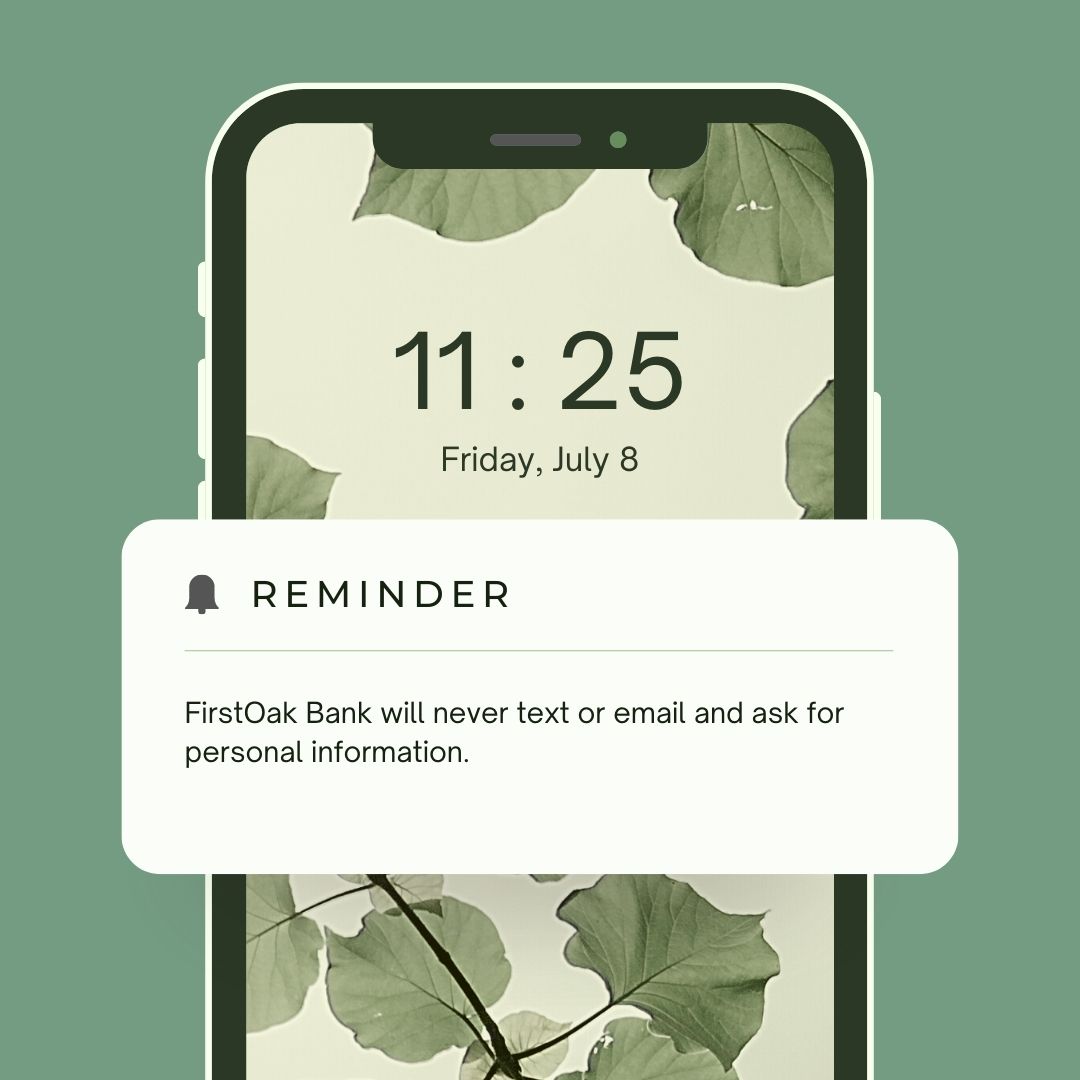
FirstOak Bank will never text or email and ask for your personal information!

Just as a reminder: FirstOak Bank will never text or email and ask for your personal information!

NEVER give away personal or financial information through email, over the phone, or via text. FirstOak Bank or other legitimate businesses will never ask for this information via these methods. Also, do not download links from suspicious emails or fill personal information into websites that these emails may direct you to. Reach out to FirstOak Bank or the company directly if you are unsure.

Identity Theft

Edler Financial Exploitation

Did you know that Elder Financial Exploitation affects at least 10% of older adults each year in the US and cost our older friends more than $3B each year?

Here are two of the most popular ways our elders are exploited:

Elder Theft
Elder Theft is stealing an older adult’s assets, funds and / or income by a trusted person.  It is often a family member, caregiver, friend, neighbor, financial services provider or other business associate – someone who typically has contact with the person’s finances who is abusing their position of trust.

Elder Scams
Elder Scams involve the transfer of money to a stranger or imposter for a promised benefit or good that the older adult didn’t receive.  Typically scammers are located outside of the United States and have no known relationship to the victim and reach out through a phone call, robo call, text, email, regular mail, through online dating apps and even through social media.  The scammers try to impersonate a person of authority like a government official, police officer or technical support rep – someone who is trusted in society and the perpetrators create high pressure situations where the victim must act immediately.  

Common Elder Scams:

  1. Government imposter scam
  2. Romance Scam through dating sites
  3. Emergency / person in-need
  4. Lottery Sweepstakes
  5. Tech and customer support

FirstOak Bank will never text or email and ask for personal information.

Identity Theft

Identity Theft

What is Identity Theft?

Identity Theft occurs when someone uses another persons identifying information such as their name, address, phone number, credit card, or social security number without their permission to commit fraud or other crimes

How to prevent Identity Theft

  • Check your credit report and use sites that regularly update you when your credit score changes or new inquiries appear on your report
  • Watch your card statements each month as they arrive for unauthorized transactions
  • Keep your social security card and other identifying information in a safe place
  • Update your software on your computer and mobile devices regularly and be sure to use anti-virus software
  • Do not respond to unsolicited or spam emails

Identity Theft

Here’s how to protect yourself from Identity and Credit Card Theft

Identity theft and credit card fraud affect a vast number of Americans each year. It is estimated by Bankrate.com that up to 41 million Americans have already had their identity stolen, and an additional 49 million people know someone that has been a victim. This boils down to 2 out of every 5 US citizens being directly affected by this epidemic. The global research and advisory firm Aite Group suggests that credit card fraud will reach $4 billion this year. Given the widespread nature of this hacking, it is important to know how it occurs and how to protect yourself.

Learn about the three most popular methods

PHISHING

In the case of phishing, a hacker calls or emails you and tricks you into giving away your financial information. Hackers impersonate legitimate businesses, government organizations, credit card companies, or even your bank to request data such as passwords and account numbers. Often times these hackers will claim that your credit card has been breached or that you have a debt that needs to be settled in order to get you to cooperate.

Here’s how to protect yourself
NEVER give away personal or financial information through email, over the phone, or via text. Legitimate companies will not ask for this information via these methods. Also, do not download links from suspicious emails or fill personal information into websites that these emails may direct you to. Reach out to the company directly if you are unsure.

HACKING

Sometimes hackers are able to obtain your credit card information by hacking the database of businesses from which you have made purchases. Oftentimes these numbers are heavily encrypted and unusable, however occasional security flaws do allow the hackers to obtain large amounts of credit card numbers.

Here’s how to protect yourself
Unfortunately, there isn’t much that you can to prevent this from happening. Some companies do allow you to store your credit card number on their website for future use. While this may seem convenient, it is best to refrain from saving your number as this provides hackers with additional ways to obtain your information.

SKIMMING

Hackers have also found a way to physically obtain your credit card information by installing electronic devices called skimmers on ATMs or gas pumps. When the card is placed into the card reader it also passes through the skimmer, allowing the information to be captured and stored.

Here’s how to protect yourself
Always inspect card readers for signs of tampering, and do not use a machine that looks suspicious. When possible, use chip readers.

For more information about how FirstOak Bank protects you from these attacks, learn more about our our new service: SiteLock
https://fo.briserv.com/resources/fraud-prevention/securelock/

Also read more about our mobile fraud prevention tips
https://fo.briserv.com/online-services/electronic-banking-tips/

You can also read more about how FirstOak handles your private information by reading our disclosures
https://fo.briserv.com/resources/disclosures/